Quantum simulation
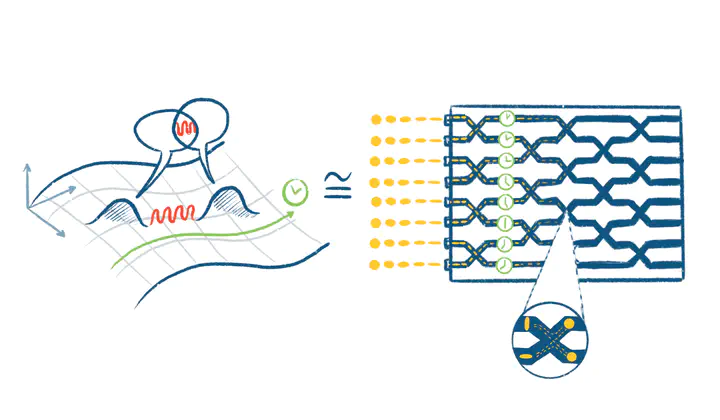
Quantum systems of many interacting particles are notoriously difficult to simulate on classical computers. This limits progress, for example, in predicting the properties of molecules or solids, or understanding fundamental questions about the non-equilibrium dynamics of complex quantum systems. A way to overcome this problem is to use computers that themselves exploit the laws of quantum mechanics to efficiently simulate quantum systems. Such a quantum simulator is able to mimic a given quantum system of interest by a synthetic quantum system in the lab. The advantage is that the latter allows us to control the simulation parameters freely and observe the system at the microscopic level.
Our task as theorists is to find suitable problems and develop tailored schemes to simulate them on a given experimental platform. An example is the simulation of quantum field theories on curved spacetimes using photons. Here, we seek to reformulate the original model in such a way that it becomes possible to map the resulting quantum dynamics onto a network of optical elements such as beam splitters and phase shifters, which can be realized experimentally, for example using wave-guide arrays.
Martin Gärttner
Group leader

Aparajita Bhattacharyya
Postdoc
Mauro D'Achille
PhD Student

Siavash Davani
PhD Student
Mirco Erpelding
PhD Student
Robin Strahlendorf
Master Student